Amargasaurus is the #6 seed in the Sauropods division of the Dinosaur Tournament.
Amargasaurus was a small but striking sauropod dinosaur known for its unusual double row of spines running down its neck and back. While it belonged to the same family as giant, long-necked plant-eaters like Diplodocus and Brachiosaurus, Amargasaurus had a unique appearance that set it apart from other members of the sauropod group. Its impressive neck spines and compact size have made it a favorite among paleontologists and dinosaur fans alike.
When and Where It Lived
Amargasaurus lived during the Early Cretaceous period, roughly 130 to 125 million years ago. Its fossils were discovered in what is now Argentina, specifically in the La Amarga Formation—hence the name Amargasaurus cazaui. During the Early Cretaceous, this region was a warm, semi-arid environment with a mix of river systems, forests, and open plains.
The ecosystem Amargasaurus inhabited included a variety of other dinosaurs, early mammals, crocodile-like reptiles, and flying pterosaurs. It shared its environment with both herbivores and predators, making its spiny features potentially important for defense or communication.
Size and Physical Characteristics
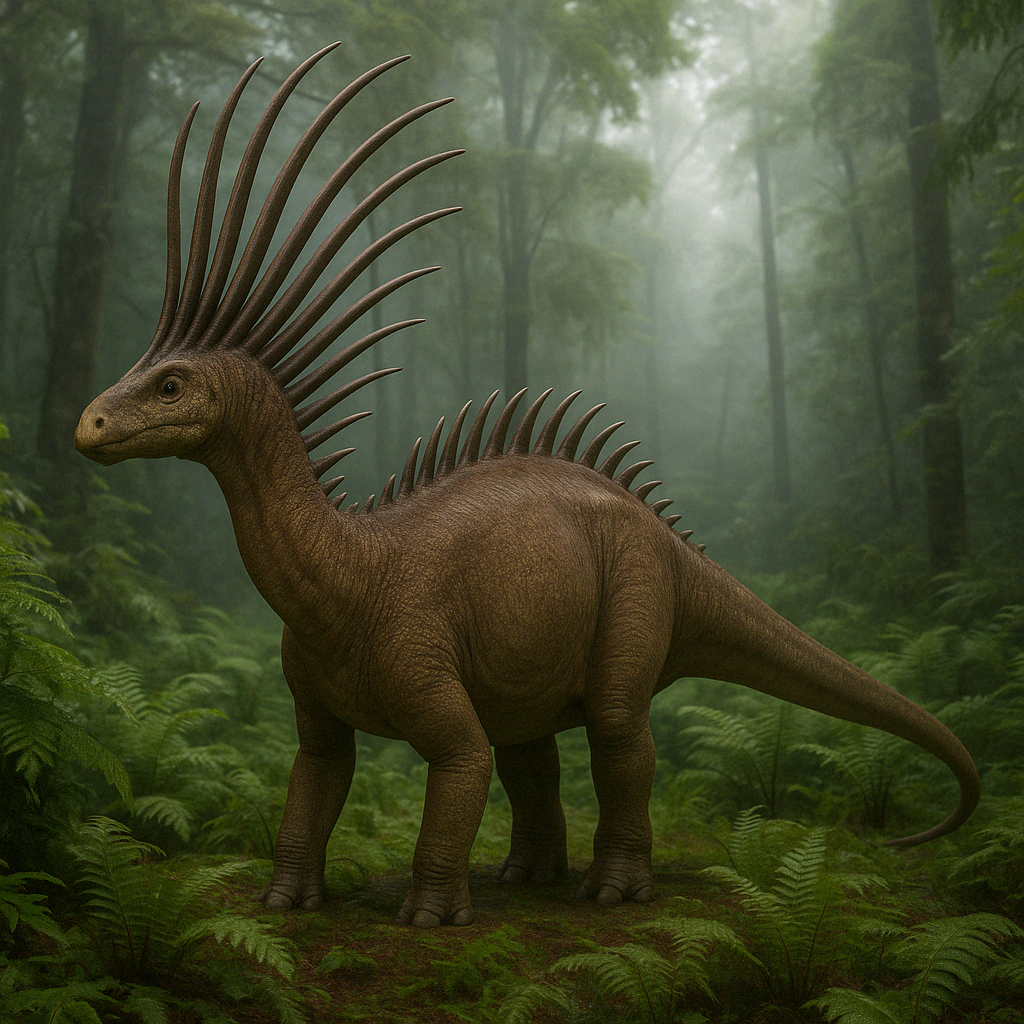
Amargasaurus was relatively small for a sauropod. It measured about 30 feet (9 meters) long and weighed an estimated 2 to 5 tons. Like its relatives, it had a long neck and tail, a barrel-shaped body, and walked on four thick, pillar-like legs.
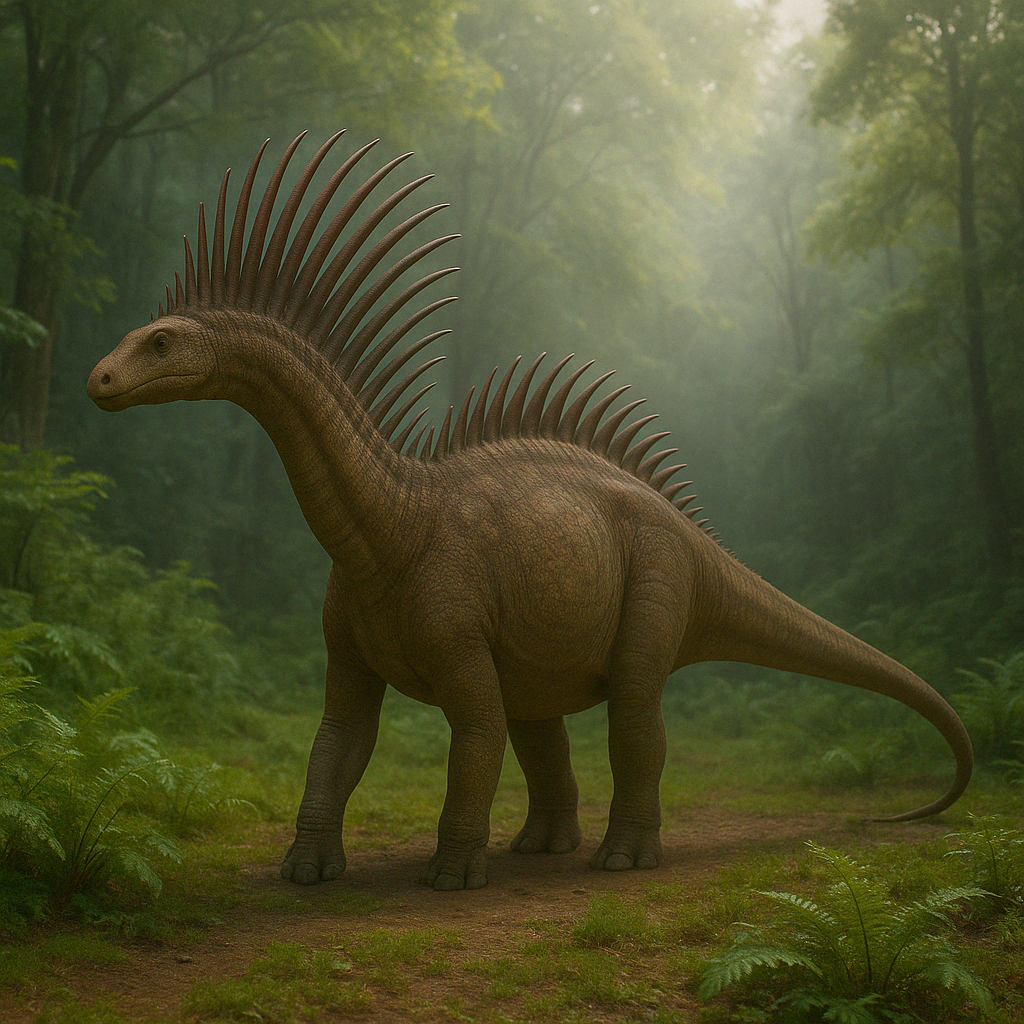
Its most distinctive feature was the double row of elongated spines extending from the neck to the middle of its back. These spines were extensions of the vertebrae and could reach over two feet (60 cm) in length. Scientists have proposed several ideas for what these spines were used for. Some believe they were connected by a skin membrane, forming a sail-like structure for display or thermoregulation. Others suggest the spines may have supported keratinous structures, like quills, used for defense or visual signaling.
Amargasaurus also had a relatively short neck compared to other sauropods, which might indicate it fed on low to mid-height vegetation. Its skull was small, with spoon-shaped teeth designed for stripping leaves from branches.
Diet and Feeding Behavior
As a herbivore, Amargasaurus fed on plants such as ferns, cycads, and early flowering plants. Its teeth were not suited for chewing but were ideal for pulling leaves off stems and branches. Like other sauropods, it likely swallowed food whole and used a large digestive system to break down the plant material over time.
Its shorter neck suggests that it may have fed closer to the ground or on shrubs rather than tall trees. This feeding strategy could have allowed it to avoid competition with larger, longer-necked sauropods by targeting different plant sources.
Discovery and Fossil Record
Amargasaurus was first discovered in 1984 by Argentine paleontologist José Bonaparte, one of the leading figures in South American dinosaur research. The fossils were found in the Neuquén Basin of Argentina, an area rich in dinosaur remains.
The type specimen of Amargasaurus is remarkably complete and includes most of the skull, vertebrae, limbs, and the all-important spines along the neck and back. This well-preserved skeleton has allowed scientists to study its anatomy in detail and compare it to other sauropods.
Amargasaurus was officially named Amargasaurus cazaui in 1991. The species name honors Luis Cazau, the geologist who helped identify the fossil site.
Scientific Importance
Amargasaurus belongs to a subgroup of sauropods called Dicraeosauridae. Unlike their gigantic cousins, dicraeosaurids were generally smaller, had shorter necks, and often had unusual spinal features. Amargasaurus is one of the most famous members of this group due to its dramatic neck spines.
Its unique skeletal features have provided valuable insight into sauropod diversity and evolution, especially in South America. The discovery of Amargasaurus also highlighted the importance of the Southern Hemisphere in dinosaur research, showing that fascinating and highly specialized species existed far from the better-known fossil sites of North America and Asia.
Amargasaurus in Pop Culture
While not as widely known as T. rex or Triceratops, Amargasaurus has made appearances in documentaries, museum exhibits, and dinosaur books, often noted for its striking spines. In recent years, it has gained more popularity thanks to its inclusion in educational programs, dinosaur video games, and toy lines.
Its unusual appearance, moderate size, and well-preserved fossils make it a favorite for scientific reconstructions and museum displays.
Final Thoughts
Amargasaurus may not have been the biggest dinosaur, but it was certainly one of the most distinctive. With its rows of tall neck spines, compact build, and important fossil record, it offers a glimpse into the incredible variety of sauropods that once roamed the Earth. As research continues, Amargasaurus stands out as a prime example of how diverse and visually unique the world of dinosaurs truly was.