Brachylophosaurus is the #10 seed in the Cerapods division of the Dinosaur Tournament.
Brachylophosaurus was a unique member of the hadrosaur family—commonly known as the “duck-billed” dinosaurs—due to its unusual head crest and the wealth of fossils that have helped paleontologists understand its life in detail. Known for its flat, paddle-shaped crest and well-preserved skeletons, Brachylophosaurus provides valuable insight into dinosaur behavior, growth, and even disease.
This Late Cretaceous herbivore may not be as widely recognized as some of its cousins, but it has earned a respected place in the story of North American dinosaurs.
When and Where It Lived
Brachylophosaurus lived around 78 to 76 million years ago during the Late Cretaceous period. Fossils have been found primarily in what is now Montana, USA, and Alberta, Canada. These regions were once part of a lush, river-filled coastal plain along the western edge of the Western Interior Seaway—a shallow sea that divided North America during the Cretaceous.
The environment would have been warm and swampy, filled with vegetation such as ferns, conifers, and flowering plants. Brachylophosaurus shared this habitat with other dinosaurs like Parasaurolophus, Corythosaurus, Gorgosaurus, and armored ankylosaurs.
Size and Physical Characteristics
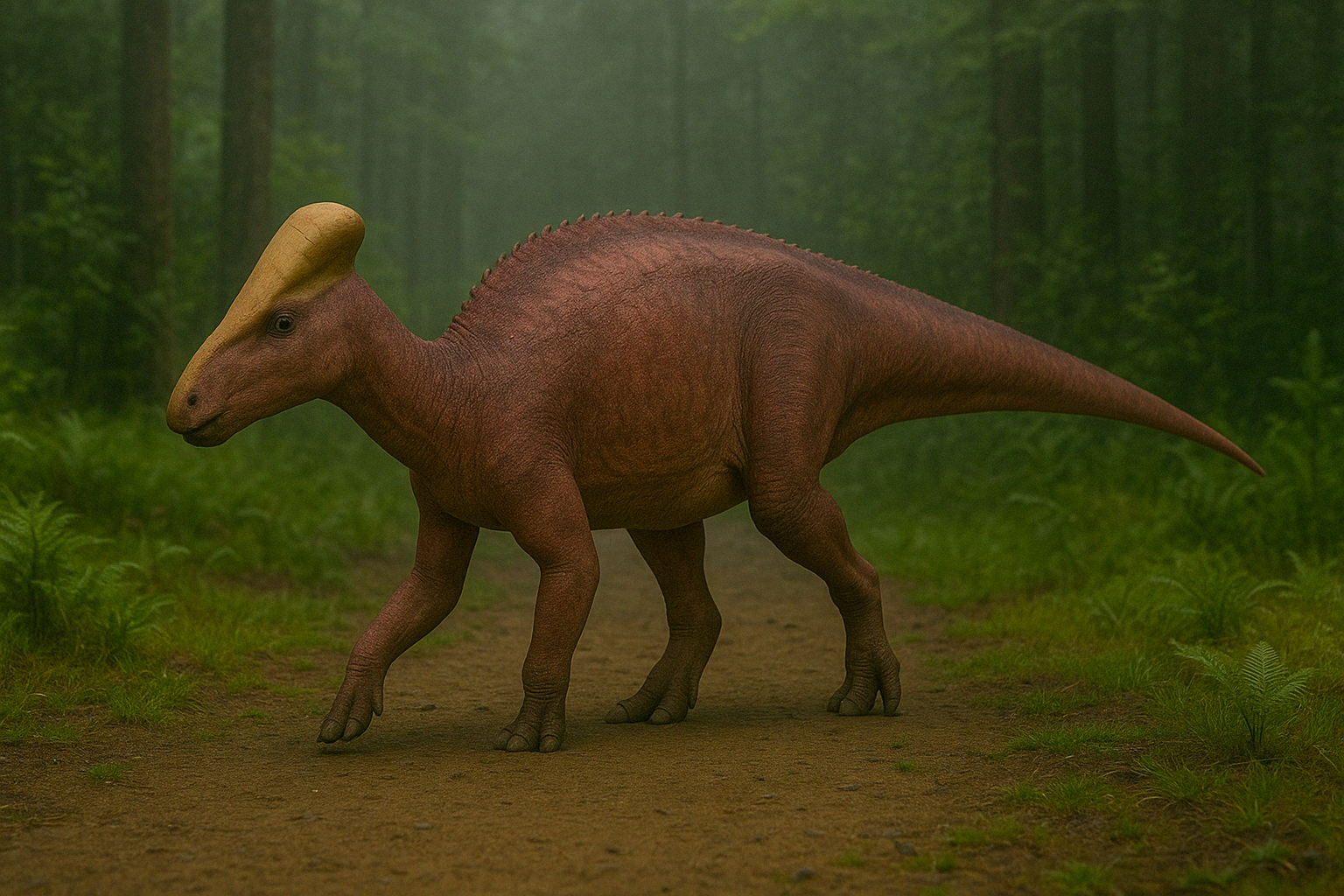
Brachylophosaurus was a large herbivore, reaching up to 30 feet (9 meters) in length and weighing between 5 and 7 tons. Like other hadrosaurs, it had a long tail, strong hind limbs for walking, and shorter forelimbs that it could use when moving slowly or foraging. It likely walked primarily on two legs but could drop to all fours when needed.
The most distinctive feature of Brachylophosaurus was its flat, broad crest, which extended backward over the top of the skull like a paddle or a surfboard. Unlike the hollow crests of other lambeosaurine hadrosaurs, Brachylophosaurus’s crest was solid and low. Scientists are still debating its function, but possibilities include visual display, species recognition, or use in social interactions like head-butting.
Its jaws were lined with hundreds of tightly packed cheek teeth that formed what’s known as a dental battery—perfect for grinding tough plant material. Its wide beak at the front of the mouth helped crop vegetation, making it a highly effective browser and grazer.
Diet and Feeding Behavior
Brachylophosaurus was a herbivore that fed on a variety of Cretaceous plant life. With its strong beak and grinding teeth, it could process ferns, conifers, and flowering plants. Its flexible neck and ability to walk on all fours allowed it to feed at different heights, from ground-level shrubs to taller plants.
Stomach content fossils from well-preserved specimens have provided direct evidence of its diet, which included leaves, twigs, and other fibrous plant material. This makes Brachylophosaurus one of the few dinosaurs for which we have a clear picture of actual dietary preferences.
Discovery and Fossil Record
The first fossils of Brachylophosaurus were described in 1953, but it wasn’t until the 1990s that the genus gained wider attention. Several nearly complete skeletons were discovered in Montana and Alberta, including one exceptionally well-preserved individual nicknamed “Elvis,” found in 1994. These fossils included skin impressions, soft tissue traces, and even internal organs—making Brachylophosaurus one of the best-preserved dinosaurs ever found.
Another famous specimen, nicknamed “Leonardo,” is considered a “dinosaur mummy.” It includes extensive skin impressions and traces of muscles, tendons, and even its last meal. This rare level of preservation has given scientists an extraordinary look into the biology and lifestyle of hadrosaurs.
Interestingly, some Brachylophosaurus fossils also showed signs of tumors, including evidence of bone cancer. This has helped paleontologists explore the occurrence of disease in prehistoric animals and how it may have affected their lives.
Scientific Importance
Brachylophosaurus is important for several reasons. Its unusual crest adds to our understanding of hadrosaur diversity and evolution. The exceptional preservation of multiple specimens provides insight into its growth, anatomy, diet, and even health.
Studies of Brachylophosaurus have also helped clarify relationships within the hadrosaur family, especially among the “crested” lambeosaurines and “flat-headed” saurolophines. It appears to be a transitional form between more primitive hadrosaurs and more advanced crested species.
The discovery of tumors in several individuals also opened new areas of research in dinosaur pathology, allowing scientists to compare ancient diseases with those seen in modern animals.
Brachylophosaurus in Popular Culture
Though it’s not as famous as T. rex or Triceratops, Brachylophosaurus has started to appear more frequently in documentaries, museum exhibits, and educational materials—largely thanks to the incredible condition of fossils like “Leonardo.” Its broad crest and mummified remains have captured the imagination of scientists and the public alike.
Some museums feature full-scale reconstructions of Brachylophosaurus, and it occasionally appears in dinosaur-themed games and media, usually noted for its distinct head shape and gentle nature.
Final Thoughts
Brachylophosaurus may not have had the tallest crest or sharpest teeth, but it’s one of the most important hadrosaurs ever discovered. From its flat-headed design to its famously preserved fossils, this dinosaur has helped paleontologists uncover new layers of detail about life in the Late Cretaceous. Whether you’re fascinated by its anatomy, its diet, or its contribution to dinosaur science, Brachylophosaurus continues to be a standout among the duck-billed dinosaurs.