Iguanodon is the #4 seed in the Cerapods division of the Dinosaur Tournament.
Iguanodon is one of the most historically significant dinosaurs ever discovered. As one of the first dinosaurs to be named and studied scientifically, it played a central role in the early development of paleontology. But Iguanodon isn’t just important because of its history—it was also a fascinating plant-eating dinosaur with some unique features, including a large thumb spike that has puzzled and intrigued scientists for generations.
When and Where It Lived
Iguanodon lived during the Early Cretaceous period, roughly 126 to 113 million years ago. Its fossils have been found throughout Europe, including England, Belgium, Germany, and Spain. Additional remains attributed to related species have been found in North Africa and Asia, showing that this group of dinosaurs had a fairly wide geographic range.
During its time, Iguanodon lived in a warm, lush environment filled with forests, rivers, and open floodplains. It would have shared its habitat with other herbivorous dinosaurs, early flowering plants, and carnivorous theropods that preyed on large plant-eaters like itself.
Size and Physical Characteristics
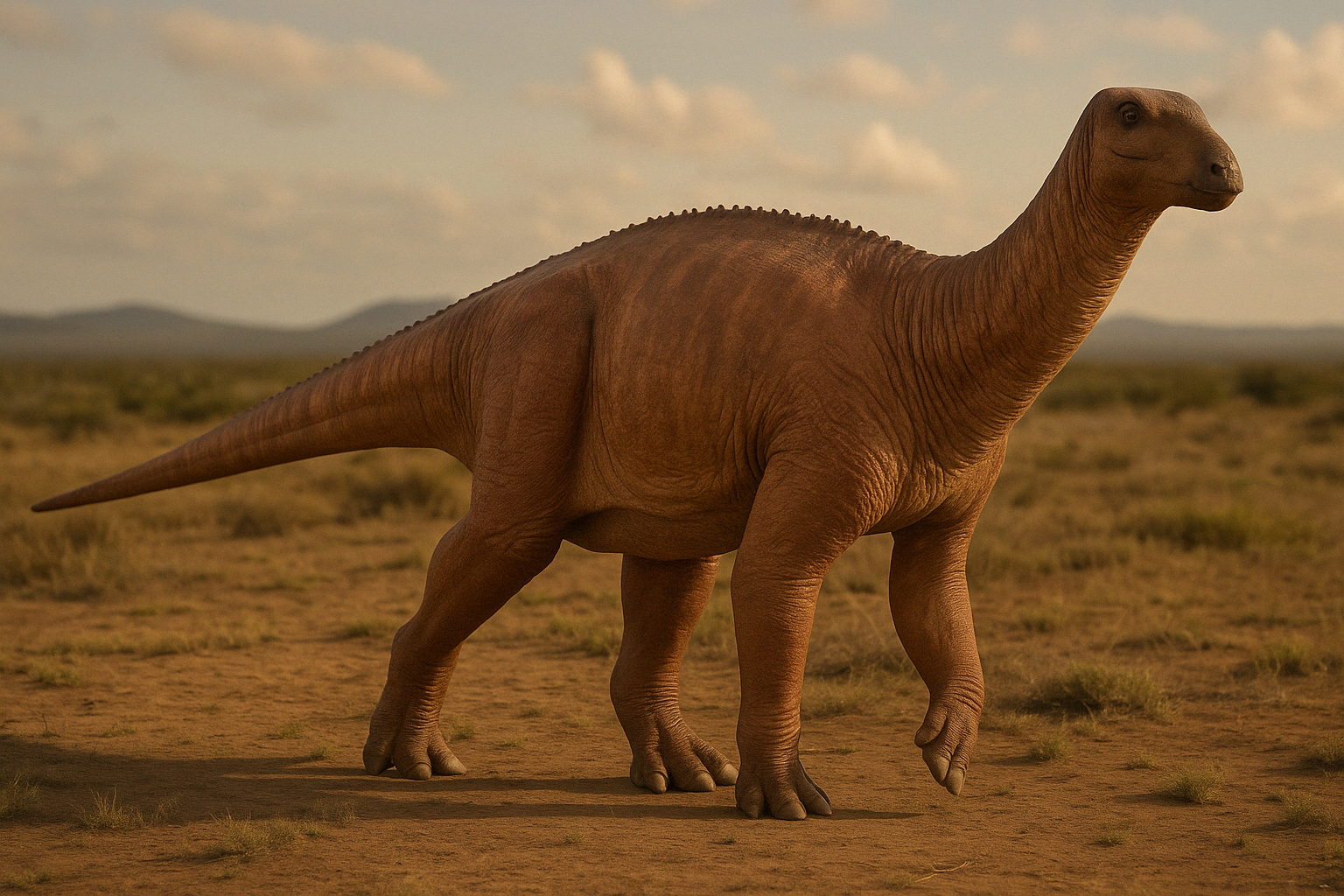
Iguanodon was a large, bulky herbivore that could grow up to 30 feet (9 meters) in length and weigh as much as 3 to 5 tons. It had a long, muscular tail, a bulky body, and powerful hind legs that allowed it to walk on two feet. However, fossil evidence shows that it was also capable of walking on all fours, especially when grazing or moving slowly.
Its arms were shorter than its legs but still quite strong, and each hand featured a distinctive thumb spike. This spike could have been used for defense against predators or for foraging—perhaps to break into tough plant material or strip leaves from branches. The other fingers included a flexible fifth digit that may have helped grasp plants, and three central fingers that were fused to form a sort of hoof-like structure for supporting weight.
The head of Iguanodon was relatively long and narrow, with a beak at the front and rows of teeth in the back of the jaw designed for grinding tough vegetation. Its name means “iguana tooth,” a reference to the similarity between its teeth and those of modern iguanas.
Diet and Feeding Behavior
Iguanodon was a herbivore that fed on a wide variety of plant material, including ferns, cycads, conifers, and some of the earliest flowering plants. Its beak allowed it to crop vegetation, while its cheek teeth were specialized for grinding food. The jaws could move in a complex chewing motion, which was more advanced than the simple up-and-down bite seen in many earlier herbivores.
With its ability to walk on all fours and rear up on its hind legs, Iguanodon could have fed on both low and moderately high vegetation. This flexibility likely gave it access to a wide range of food sources in its environment.
Discovery and Fossil Record
Iguanodon was one of the very first dinosaurs ever discovered and scientifically described. Its fossils were first found in England in the early 1820s by Dr. Gideon Mantell. At the time, the idea of “dinosaurs” didn’t even exist yet. Mantell originally believed he had found the remains of a giant, extinct reptile related to modern lizards.
In 1825, Iguanodon was officially named, and in 1842, it became one of the three original dinosaurs included in the newly coined term “Dinosauria,” alongside Megalosaurus and Hylaeosaurus.
Later, in the 1870s, a massive discovery of nearly complete Iguanodon skeletons was made in a Belgian coal mine at Bernissart. These remains allowed scientists to reconstruct the animal’s full skeleton for the first time and led to the first life-sized mount of a dinosaur in a museum.
Scientific Importance
Iguanodon has played a major role in the history of paleontology. Its early discovery helped spark scientific interest in extinct reptiles and led to the development of dinosaur science as a field. Over the years, changing interpretations of Iguanodon’s posture—from a kangaroo-like stance to a more horizontal body with quadrupedal movement—have reflected the evolution of paleontological methods and understanding.
Iguanodon is also a key example of an ornithopod dinosaur, a group known for its advanced chewing systems and social behavior. It is considered a close relative of later hadrosaurs, or “duck-billed” dinosaurs, which became some of the most successful herbivores of the Late Cretaceous.
Iguanodon in Popular Culture
Thanks to its early fame, Iguanodon has appeared in many books, films, and documentaries. It was prominently featured in Disney’s Dinosaur (2000), and models of Iguanodon were part of the famous Crystal Palace dinosaur sculptures in London, which date back to the 1850s.
It’s also a staple in museum exhibits and dinosaur-themed learning materials, especially in Europe, where many of its fossils have been discovered.
Final Thoughts
Iguanodon is more than just a dinosaur with a spiky thumb—it’s a pioneer of paleontology. Its fossil discoveries helped launch the scientific study of dinosaurs and continue to inform our understanding of how herbivorous dinosaurs lived, moved, and fed. With its iconic profile and important place in science history, Iguanodon remains a favorite among researchers and dino fans around the world.