Corythosaurus is the #6 seed in the Cerapods division of the Dinosaur Tournament.
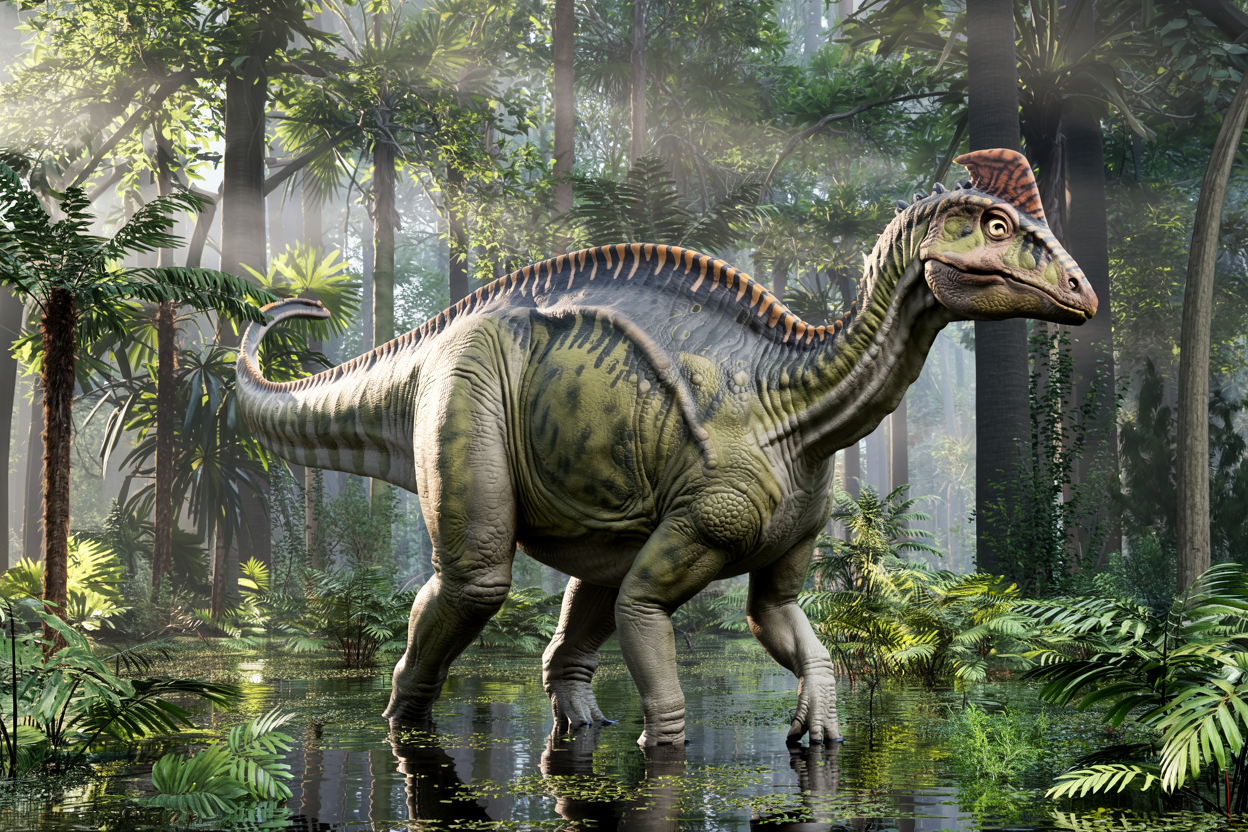
Corythosaurus is one of the most famous and easily recognizable members of the hadrosaur family, also known as “duck-billed dinosaurs.” What sets this dinosaur apart is its impressive, helmet-like crest, which gives it a unique and almost regal appearance. With its elegant shape, social behavior, and fascinating vocal abilities, Corythosaurus stands out as one of the most interesting herbivores of the Late Cretaceous period.
When and Where It Lived
Corythosaurus lived approximately 77 to 75 million years ago during the Campanian stage of the Late Cretaceous period. Fossils of this dinosaur have been discovered primarily in western North America, including Alberta, Canada, and Montana, USA. These areas were once part of the ancient landmass Laramidia, which was split from the eastern half of North America by a shallow inland sea.
The environment during Corythosaurus’s time was warm and humid, with coastal plains, river deltas, and dense vegetation. This lush ecosystem supported a variety of dinosaur species, including other hadrosaurs, horned dinosaurs like Centrosaurus, and predators such as Gorgosaurus.
Size and Physical Characteristics
Corythosaurus was a large, bipedal or quadrupedal herbivore. It measured about 30 to 33 feet (9 to 10 meters) in length and weighed an estimated 3 to 4 tons. It had a long, flat tail used for balance, powerful hind legs for walking or running, and shorter front limbs that could be used for walking when necessary.
Its most striking feature was the tall, curved crest on the top of its head. The crest resembled a Corinthian helmet—hence the name Corythosaurus, which means “helmet lizard.” Inside the crest were hollow passages connected to the nasal passages, forming an intricate series of tubes.
These tubes likely served multiple purposes. They may have amplified calls, allowing Corythosaurus to produce low-frequency sounds for communication over long distances. The crest might have also played a role in visual display, species recognition, and even thermoregulation.
Diet and Feeding Behavior
Corythosaurus was a herbivore that fed on a wide variety of plant material. Its beak-like mouth and rows of grinding teeth—arranged in what are known as dental batteries—allowed it to chew tough vegetation efficiently. It likely ate ferns, horsetails, conifers, and flowering plants.
Its ability to walk on both two and four legs would have allowed it to reach vegetation at various heights. While grazing, it may have used all four limbs to support itself, and when moving quickly or scanning its surroundings, it could rise up onto its hind legs.
The highly efficient chewing system and strong jaw muscles of Corythosaurus made it one of the most advanced plant-eating dinosaurs of its time.
Discovery and Fossil Record
Corythosaurus was first described in 1914 by Canadian paleontologist Barnum Brown, based on a nearly complete skeleton found in Alberta’s Dinosaur Provincial Park. This initial specimen included skin impressions, which provided rare and valuable information about the texture and appearance of the dinosaur’s body.
Since then, multiple specimens of Corythosaurus have been uncovered, including juveniles and adults, helping scientists understand its growth, crest development, and variation within the species. Its fossils are among the best-preserved of any hadrosaur, and many skeletons include detailed skulls with intact crests.
There has been some debate over how to classify certain similar-looking dinosaurs, but Corythosaurus remains one of the most well-known lambeosaurines—a subgroup of crested hadrosaurs.
Scientific Importance
Corythosaurus has played a major role in our understanding of dinosaur communication, behavior, and social structure. The hollow crest is a unique feature among dinosaurs and has been studied extensively to model how the animal might have produced sound. Computer simulations and physical models suggest that it could make low, resonant calls that may have been used for mating, warning, or communication within a herd.
Corythosaurus also helps paleontologists understand how hadrosaurs grew and developed. Juvenile specimens with small or undeveloped crests suggest that the structure became more pronounced as the animal matured, likely playing a role in adult social interaction or mate selection.
Corythosaurus in Popular Culture
Thanks to its distinctive crest and well-preserved fossils, Corythosaurus has appeared in books, documentaries, and museum exhibits around the world. It has also featured in several dinosaur-themed movies and television shows, often portrayed as a peaceful, social plant-eater.
Its dramatic head shape makes it a favorite among dinosaur enthusiasts and a common subject in paleoart and educational materials.
Final Thoughts
Corythosaurus was more than just a dinosaur with a funny-shaped head—it was a social, intelligent herbivore that used sound, sight, and movement to interact with others in its environment. Its advanced chewing abilities, elaborate crest, and well-preserved fossils have made it a star in the world of paleontology. As scientists continue to study Corythosaurus, it continues to help us piece together the puzzle of dinosaur behavior and evolution in the Late Cretaceous.