Dilophosaurus is the #4 seed in the Theropods division of the Dinosaur Tournament.
Dilophosaurus is one of the earliest known large predatory dinosaurs, easily recognized by the pair of crests on top of its head. While it gained popularity through its dramatic appearance in movies, the real dinosaur was quite different from its Hollywood version. Nevertheless, Dilophosaurus remains a fascinating and important species in the story of dinosaur evolution.
When and Where It Lived
Dilophosaurus lived during the Early Jurassic period, about 193 million years ago. Its fossils have been found in what is now the southwestern United States, particularly in Arizona. During the time Dilophosaurus lived, the region was part of a warm, river-filled landscape that supported a variety of early dinosaurs, reptiles, and amphibians.
Size and Physical Features
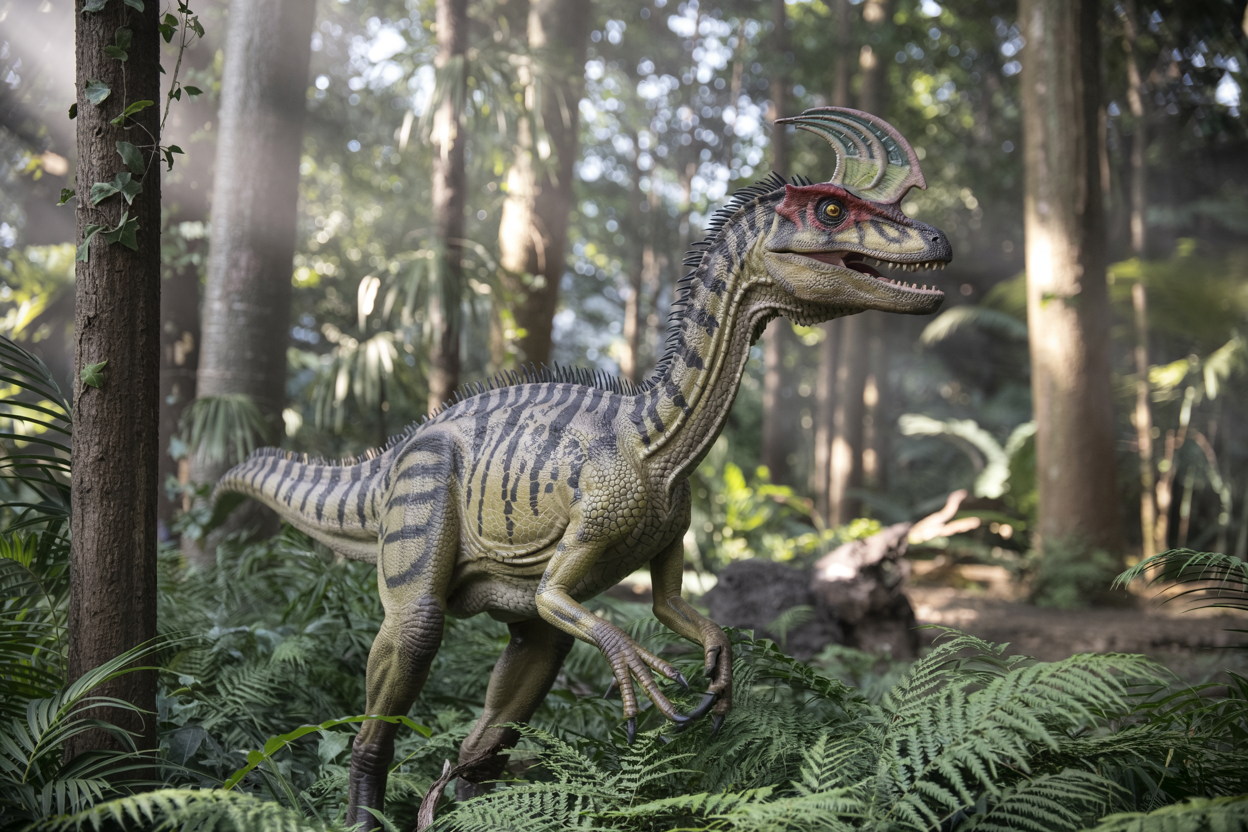
Dilophosaurus was a medium to large-sized theropod dinosaur. It could grow up to 20 feet (6 meters) in length and weigh around 900 to 1,100 pounds (400 to 500 kilograms). It walked on two legs, had a long tail for balance, and had three-fingered hands with sharp claws.
Its most striking feature was the pair of thin, curved crests on top of its skull. These crests were likely used for display—possibly to attract mates or communicate with others of its kind. They were too fragile to be used in combat or defense.
The skull of Dilophosaurus was long and narrow, with large openings that made it lighter. Its teeth were sharp and curved, ideal for eating meat. The upper jaw had a noticeable gap behind the front teeth, which may have helped it grip struggling prey.
Hunting and Diet
As a carnivore, Dilophosaurus likely preyed on smaller animals, including early reptiles, fish, and possibly small dinosaurs. It may have also scavenged on carcasses when the opportunity arose. Its long legs suggest it was built for speed, making it a capable hunter.
Unlike the version seen in movies, there’s no evidence that Dilophosaurus had a frill around its neck or could spit venom. These features were fictional additions and aren’t supported by fossil evidence.
However, its physical build—with strong legs, grasping hands, and sharp teeth—indicates it was a skilled predator in its environment.
Discovery and Fossil Evidence
The first Dilophosaurus fossils were discovered in 1942 by a Navajo man named Jesse Williams near Tuba City, Arizona. The bones were later studied by paleontologist Sam Welles, who initially thought they belonged to a new species of Megalosaurus. In 1970, Welles gave it the name Dilophosaurus wetherilli, meaning “two-crested lizard,” in honor of the crests on its skull.
Since then, more fossil material has been uncovered, helping scientists learn more about its anatomy, behavior, and evolutionary relationships. These fossils show that Dilophosaurus had many primitive features, linking it to earlier dinosaur species, while also displaying more advanced traits typical of later theropods.
Role in Evolution
Dilophosaurus is important because it helps paleontologists understand how early theropods evolved into larger and more specialized predators. It sits near the base of the theropod family tree, sharing traits with both primitive meat-eaters and later, more advanced species like Allosaurus and T. rex.
Its combination of speed, size, and unique display structures shows that even early dinosaurs were experimenting with a wide range of adaptations. This variety helped dinosaurs become the dominant land animals for millions of years.
Pop Culture and Misconceptions
Dilophosaurus became widely known after appearing in the 1993 movie Jurassic Park. In the film, it was shown as a small dinosaur with a neck frill and the ability to spit venom—features that made for great drama but aren’t backed by science.
In reality, Dilophosaurus was much larger and lacked those fictional traits. While the movie helped boost public interest in dinosaurs, it also created confusion about what the real animal was like. Today, scientists continue to clarify those differences through fossil research and public education.
Final Thoughts
Dilophosaurus was a fast, agile predator and one of the earliest large theropods to appear after the Triassic period. Its twin crests make it instantly recognizable, and its place in dinosaur evolution makes it scientifically important.
Even though it’s often misunderstood thanks to Hollywood, the real Dilophosaurus was impressive in its own right—a dynamic hunter that played a key role in shaping the future of carnivorous dinosaurs.