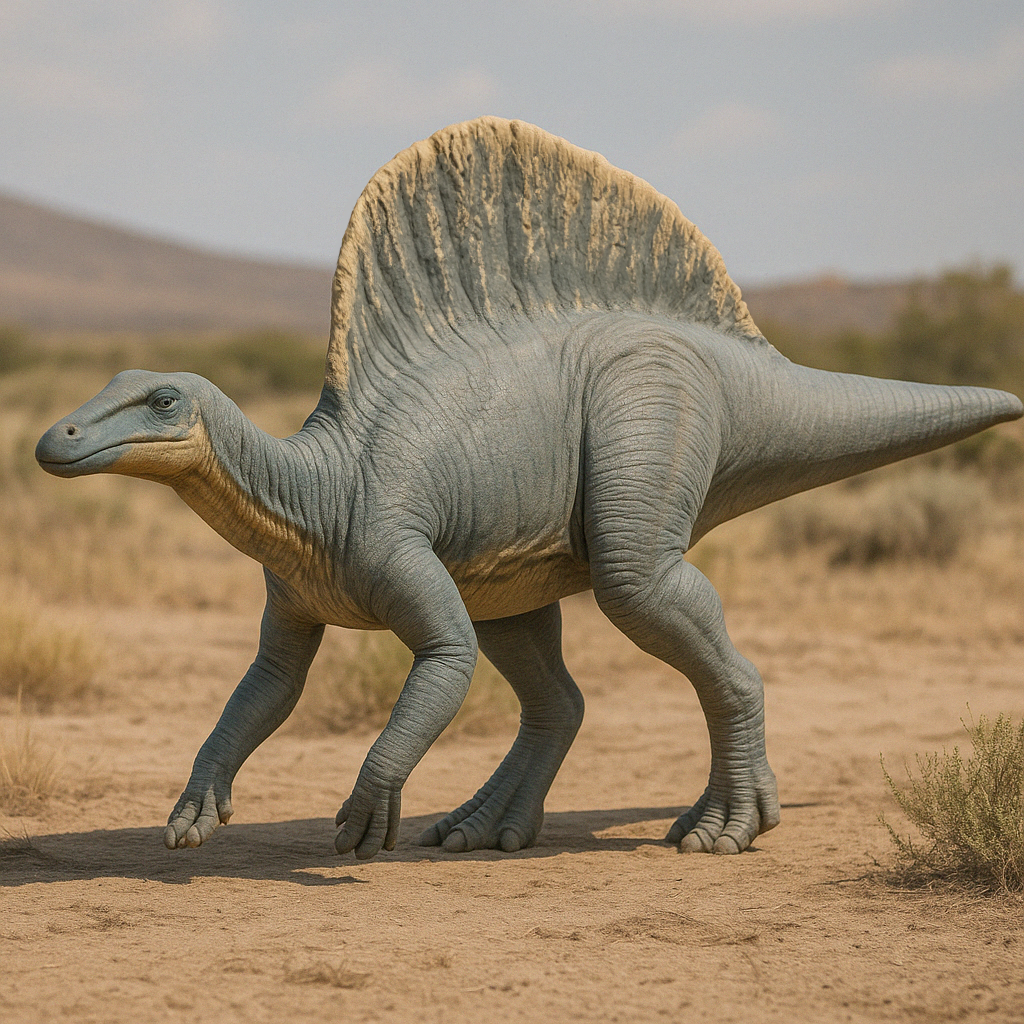
Ouranosaurus is the #12 seed in the Cerapods division of the Dinosaur Tournament.
Ouranosaurus was a unique herbivorous dinosaur that stood out from its relatives thanks to a distinctive sail-like structure on its back. This sail, formed by long neural spines, has made Ouranosaurus one of the most visually interesting dinosaurs from the Early Cretaceous period. A member of the iguanodont family, Ouranosaurus combined familiar features seen in other plant-eating dinosaurs with a few bold traits that continue to intrigue paleontologists.
When and Where It Lived
Ouranosaurus lived during the Early Cretaceous period, approximately 125 to 110 million years ago. Fossils of this dinosaur have been found in present-day Niger, in northern Africa. During the Early Cretaceous, this region was a warm, wet environment filled with rivers, lakes, and rich vegetation. It would have supported a wide variety of prehistoric life, including both plant-eaters and large carnivorous dinosaurs like Suchomimus.
The area where Ouranosaurus was discovered is part of the Elrhaz Formation, a fossil-rich deposit that has yielded many significant dinosaur finds. The environment likely experienced seasonal changes, with wet and dry periods that would have influenced vegetation patterns and animal behavior.
Size and Physical Characteristics
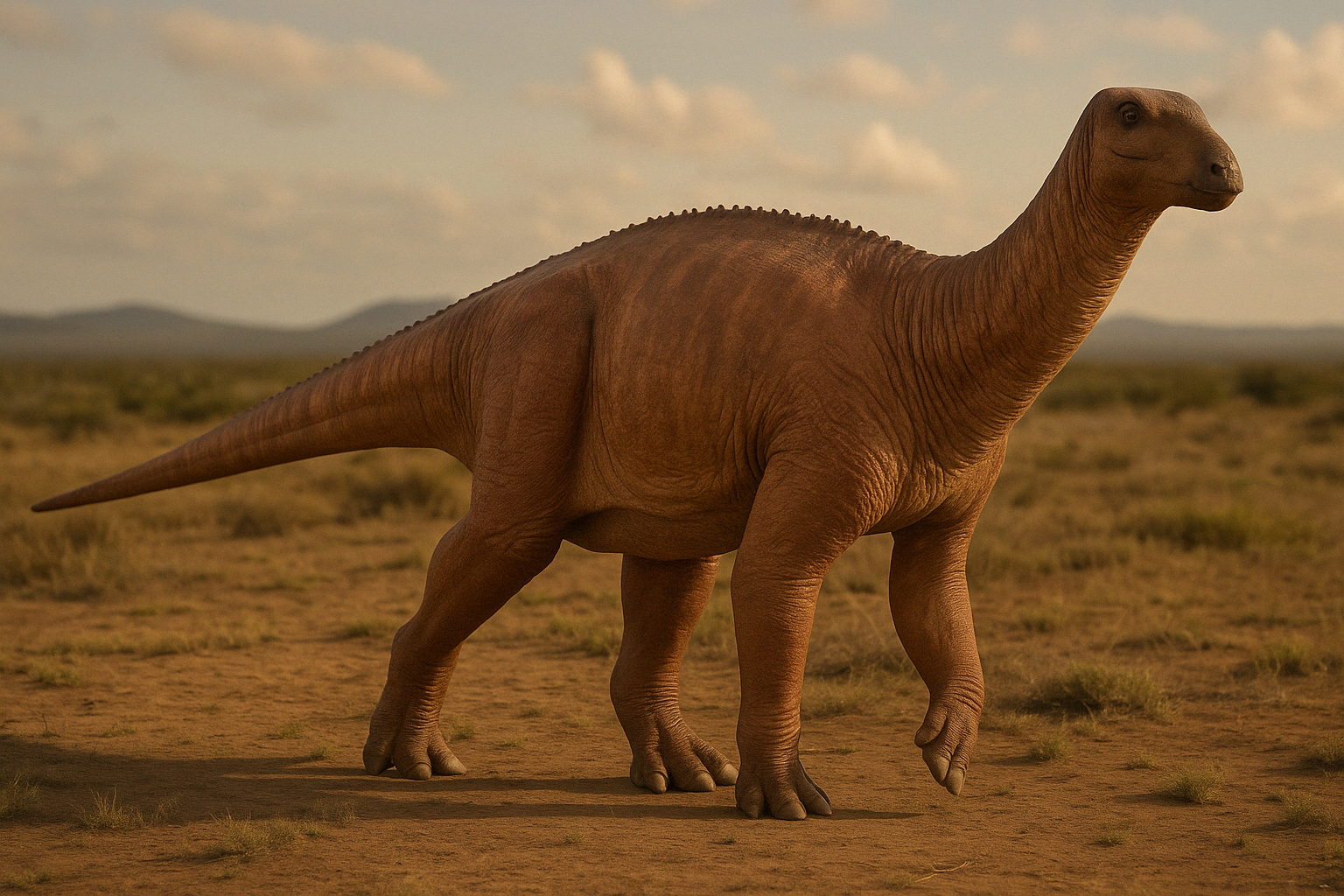
Ouranosaurus was a medium to large herbivore. It measured about 23 to 27 feet (7 to 8 meters) in length and likely weighed around 2 to 4 tons. Its body was relatively low and long, with a narrow snout, powerful hind legs, and shorter front limbs. Like other iguanodonts, it could walk on two legs but also used all four for slow movement and feeding.
The most distinctive feature of Ouranosaurus was its tall, spiny sail that ran along its back and hips. This sail was made from elongated neural spines—extensions of the vertebrae—which could reach over two feet in height. The exact purpose of this sail is still debated. Some scientists believe it was used to regulate body temperature, while others think it may have been a display structure used to attract mates or signal to other members of the species.
Another notable trait was its broad, flat thumb spike—a characteristic of iguanodonts, though less pronounced in Ouranosaurus than in some of its relatives like Iguanodon. Its head featured a beak at the front for cropping plants and a set of leaf-shaped cheek teeth well-suited for chewing tough vegetation.
Diet and Feeding Behavior
Ouranosaurus was an herbivore and likely fed on a variety of low to mid-height plants, including ferns, cycads, and early flowering plants. Its beak allowed it to snip leaves and stems, while its teeth and strong jaw muscles helped it grind plant material for easier digestion.
Its long arms and flexible neck gave it a wide feeding range. It could probably rear up slightly to reach higher branches or drop to all fours to browse close to the ground. Like other large herbivores, it likely spent much of its day foraging in groups, moving slowly through the landscape in search of food.
Discovery and Fossil Record
Ouranosaurus was first discovered in 1965 by French paleontologist Philippe Taquet during an expedition to Niger. It was formally named Ouranosaurus nigeriensis in 1976. The name means “brave lizard from Niger,” with “Ouranos” derived from a Tuareg word meaning “brave” or “valiant.”
Two fairly complete skeletons were uncovered, providing a wealth of information about the animal’s anatomy. These fossils included nearly complete skulls, spines, limbs, and the iconic sail structure. Because of this well-preserved material, Ouranosaurus is one of the better-known African dinosaurs from the Early Cretaceous.
Scientific Importance
Ouranosaurus has helped paleontologists better understand the diversity of iguanodont dinosaurs and their adaptations. Its combination of features—such as its sail, limb proportions, and skull structure—makes it a valuable transitional form between more primitive ornithopods and the later, more specialized hadrosaurs (duck-billed dinosaurs).
The sail, in particular, has sparked significant interest. If it served a thermoregulatory function, it may have helped Ouranosaurus stay cool in the heat of Cretaceous Africa. If it was for display, it suggests complex social behavior. Ongoing research continues to explore these possibilities using comparisons with other sail-backed animals like Spinosaurus or modern reptiles with similar structures.
Ouranosaurus in Popular Culture
Although not as famous as some of its dinosaur contemporaries, Ouranosaurus has appeared in books, documentaries, and museum exhibits. Its sail makes it a striking subject for paleoart and dinosaur reconstructions, and it has begun to feature in more children’s educational materials and dinosaur-themed games.
Several museums, including the National Museum of Niger and the Natural History Museum in Paris, feature casts or displays of Ouranosaurus skeletons, helping to bring this African dinosaur to life for the public.
Final Thoughts
Ouranosaurus may not be a household name, but it’s one of the most distinctive plant-eaters of the Early Cretaceous. With its sail-backed profile, flexible movement, and well-preserved fossils, it continues to intrigue scientists and delight dinosaur enthusiasts. As research continues, Ouranosaurus stands as a reminder that some of the most interesting dinosaurs aren’t always the biggest or the most famous—but often the ones with the most unusual adaptations.