Spinosaurus is the #3 seed in the Theropods division of the Dinosaur Tournament.
Spinosaurus is one of the most unusual and fascinating dinosaurs ever discovered. With its long crocodile-like snout, towering sail, and possible swimming abilities, Spinosaurus stood apart from its more famous cousins like Tyrannosaurus rex and Velociraptor. New discoveries over the past two decades have changed how scientists view this dinosaur, revealing a predator uniquely adapted for life both on land and in water.
Basic Facts
Spinosaurus aegyptiacus lived approximately 99 to 93 million years ago during the mid-Cretaceous period. Its fossils have been found primarily in what is now North Africa, including Egypt and Morocco. This region was once a lush, river-filled environment, home to many fish, crocodile-like reptiles, and other dinosaurs.
Estimates suggest that Spinosaurus was one of the longest and heaviest carnivorous dinosaurs. It likely measured between 49 and 52 feet (15 to 16 meters) in length and weighed 7 to 10 tons. That makes it longer than T. rex, though lighter in build.
Unique Appearance
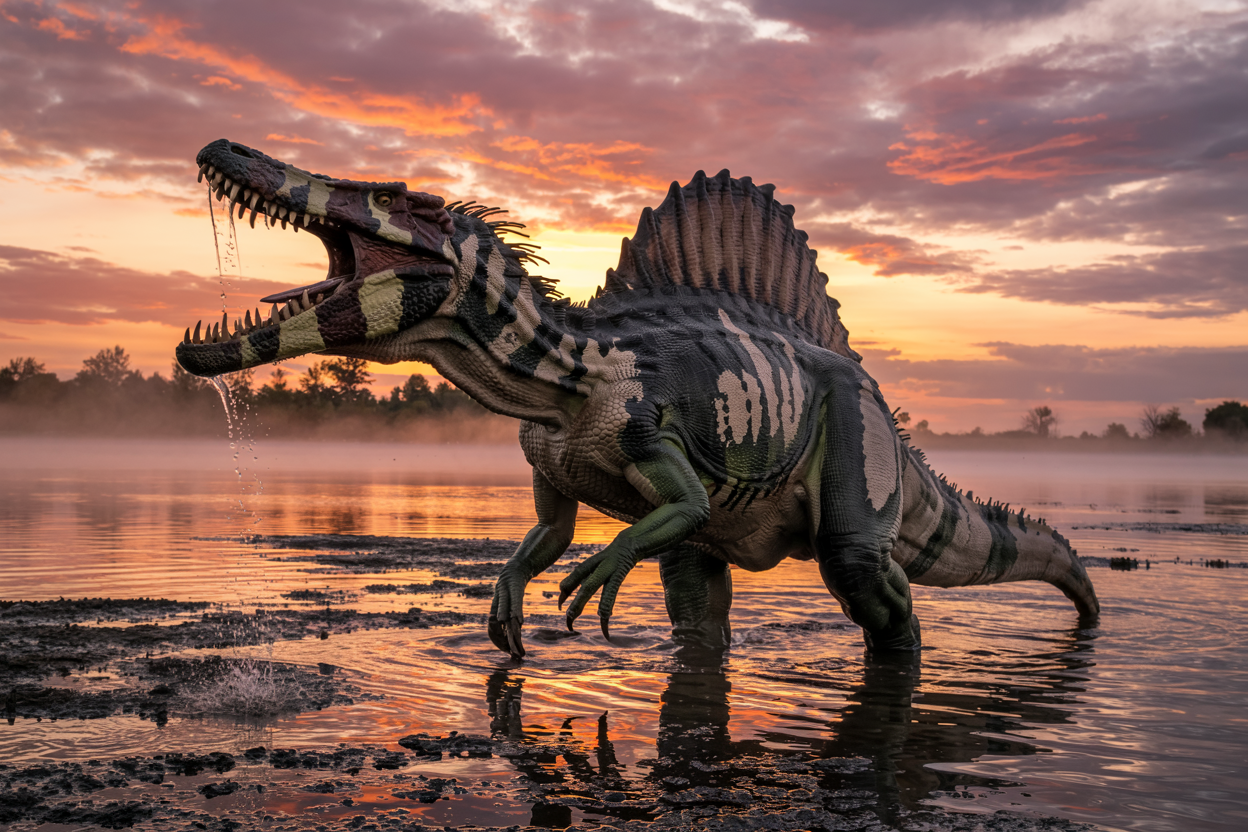
One of the most distinctive features of Spinosaurus is the tall sail on its back. This sail was formed by long, thin neural spines extending from its vertebrae, some of which reached over 5 feet (1.5 meters) in height. Scientists aren’t entirely sure what the sail was used for, but theories include thermoregulation (controlling body temperature), display to attract mates or intimidate rivals, and helping with balance or swimming.
Spinosaurus also had a long, narrow skull full of conical teeth—perfect for gripping slippery prey like fish. Its nostrils were positioned farther back on the snout, which may have helped it breathe while its head was partly underwater, similar to how crocodiles hunt today.
Unlike most theropods, Spinosaurus had relatively short hind legs and may have walked on all fours at times. Its front limbs were strong and equipped with large claws, likely useful for grabbing prey or supporting its weight on land.
A Dinosaur That Could Swim?
Perhaps the most surprising discovery about Spinosaurus is its potential as a semi-aquatic dinosaur. In recent years, fossil evidence has revealed features that suggest it spent a significant amount of time in the water.
Its dense bones may have helped with buoyancy control, and its paddle-like tail was likely used for propulsion while swimming. Some researchers believe it hunted fish by wading through shallow rivers or diving below the surface. Its habitat was full of aquatic prey, including large sawfish and coelacanths, which would have been a steady food source.
While debate continues about exactly how aquatic Spinosaurus was, it’s now widely accepted that it was better adapted to water than any other known dinosaur.
Discovery and History
Spinosaurus was first described in 1915 by German paleontologist Ernst Stromer, based on fossils found in Egypt. Unfortunately, the original fossils were destroyed during a World War II bombing raid in Munich, leaving little evidence for many years.
New discoveries in the early 2000s reignited interest in Spinosaurus, especially after a partial skeleton was uncovered in Morocco. This specimen, along with additional bones and advanced imaging techniques, gave scientists a clearer picture of Spinosaurus’s unique anatomy and lifestyle.
Pop Culture and Public Interest
Spinosaurus gained widespread attention after appearing as the main dinosaur antagonist in the 2001 movie Jurassic Park III. In the film, it was portrayed as even more powerful than T. rex, sparking plenty of debate among fans and paleontologists. While the movie version took creative liberties, it helped bring attention to a dinosaur that was, at the time, not as well-known to the general public.
Since then, Spinosaurus has become a staple in documentaries, books, and toy lines. Its unusual body plan and aquatic habits make it one of the most visually striking dinosaurs ever imagined.
Final Thoughts
Spinosaurus continues to challenge what we thought we knew about dinosaurs. It’s a reminder that prehistoric life came in all shapes and sizes—and that we’re still learning new things every year.
With its crocodile-like jaws, towering sail, and possible swimming ability, Spinosaurus shows us just how diverse and adaptable dinosaurs were. It wasn’t just a land-based predator—it may have ruled the rivers as well.